Idea & Script
- 12 January 2026
- 8 min read
It was shortly before Doreen and I lost our passports, cell phones, airline tickets, debit cards, and all our cash while on vacation in Croatia. It was like a flash of inspiration that shot through my mind: the idea for my semester project film.
And when we finally left our most important travel bag while hitchhiking in a truck on the same day in a small village on the Croatian cliff, it could not cloud the joy of my previously found thought. I was sure it was the right one after I thought through thousands of others.
The first sketch of ideas
In a McDonalds, a man persuades another to raid the restaurant. This small possible story met all the requirements I had previously set myself: two performers, one filming location, one conflict. I had to make the limits for several reasons. On the one hand, so that the feasibility remained in the context of a semester, on the other hand, I had learned from previous projects that a short film is just a short film, and an excess of plot and despise can only be processed superficially. With such a simple scheme, I was able to develop the plot freely and had enough space for details. The third and most important point was the concentration on the spectacle: My requirements deliberately required the direct permanent exchange between the two representations in dialogue, verbally as well as non-verbally.
Before I come to the drafting, I would like to briefly discuss alternative ideas. The filming location could have been, for example, a car, one character a loner who drives the car, the other a vagrant who wants to ride along. Actually very charming, but already used too often, such as in “In July” by Fatih Akin. Here, the following aspect would have fit: It had to be a space that binds the two to each other so that they have to deal with each other and with their conflict. The whole story transferred to a bus with bus driver and passenger also had a lot of potential, but I doubted the feasibility. It had to be as simple but also interesting as possible.
A few days earlier, when I had left my photo camera in a cemetery in Šibenic, the thought came to me that this could be the subject of my narrative, the protagonist of the film. The story of a camera, the photos she had taken, the places and people she had seen, from birth to her death. I would still like to implement the story, but in a larger context.
The Elaboration
The thought of persuasion is not new, of course. In many films, I've seen this dramaturgical means to initiate a narrative, or to simply build up tension. One wants, the other doesn't want to. How will they agree? Why doesn't the other want to? How will one convince the other? The conflict is present on both sides, passive and active can alternate, the motivations of the characters are clear. I wanted to go through and write through this conflict myself. It is like playing chess against yourself, taking the position of the impartial spectator. I know the strategies of the two parties and I have to build them against each other. And if possible, without becoming schizophrenic.
Well, I had the core idea, but no development, no beginning, no end. Now I needed material. I call this phase maturation process, because in the most impossible situations you come up with small ideas, which you can not incorporate but do not have to. I didn't write anything down in time, my memory was the filter of the whole, because good ideas get stuck, bad ideas fall through. The exchange of ideas with friends and dores was also very important to me. They enabled new perspectives.
In my travel reading in Croatia was “Script Writing for Television and Film” by Syd Field. It is good for the most basic basics, it works through the “incontrovertible” script structure. And it reminds you of the really important points in writing. In addition to some meaningful hints, such as the sorting of sequences on flashcards, the question of the worldview of the figures, or the thesis, one should only begin writing if one knows the beginning and the end’ 1) the established rules helped me to have a mental support on which I could build when working. The workshop of Jürgen Seidler a few semesters earlier supplemented this basic structure. He is the author of the German script agency Scripthouse.
Through another project before, I had a lot of concern for the credibility of the dialogue. Would the characters seem like from real life? Does the text work? Will it look like cut together? The solution to this, provided you have a good text and good actors, I hoped to get by shooting with 2 cameras. One on each of the performers. Thus, I had the opportunity to determine the cut in retrospect, depending on the movements of the actors. We were also able to rotate long passages in one piece without risking connection errors, such as a cigarette burned down for different lengths, or different postures.
The script
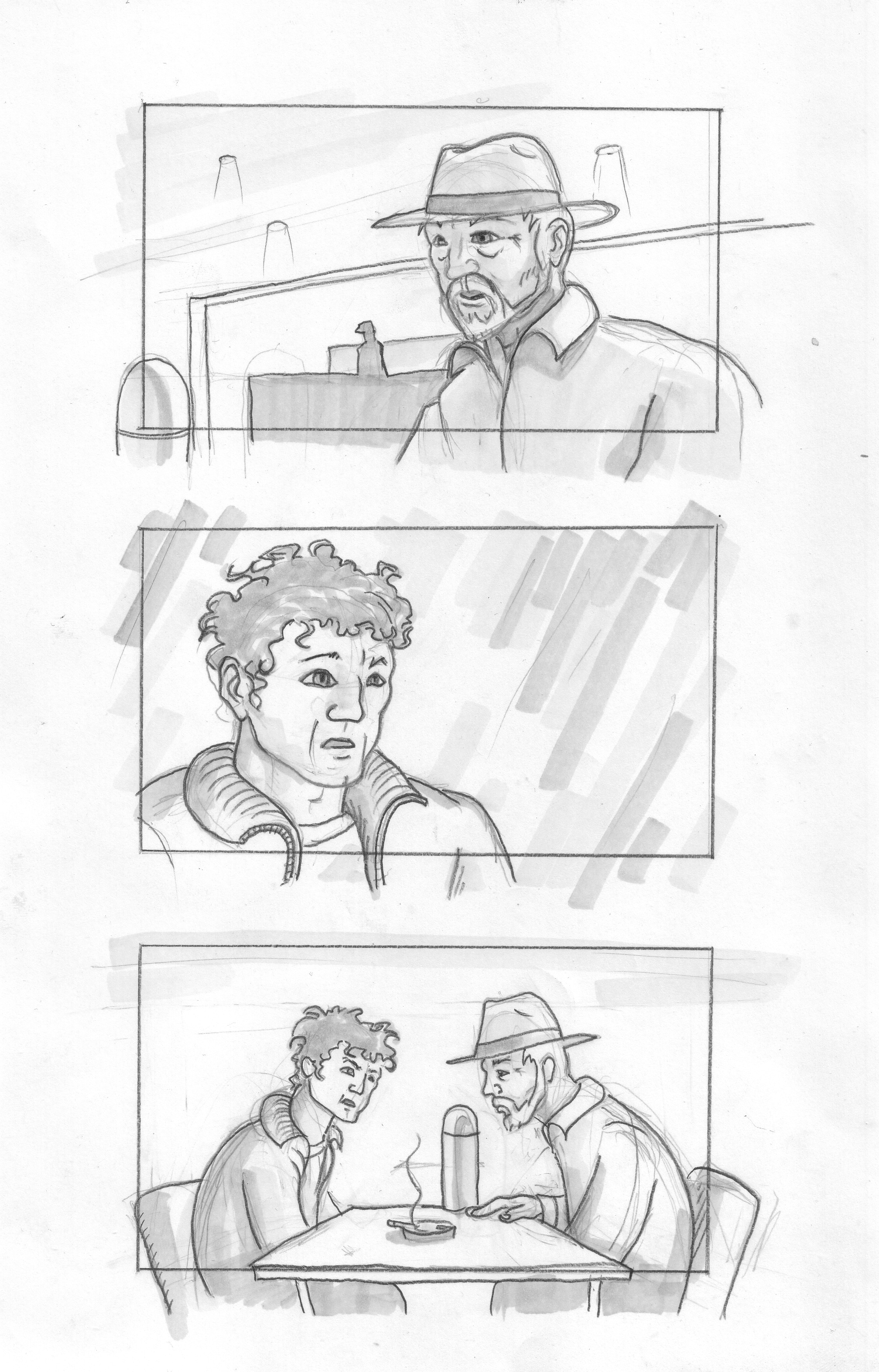
Without taking any notes beforehand, I drove to Berlin to meet Michaela Beck, a screenwriter who had taught at our university two semesters earlier, for two hours. She told me the questions I had to ask myself from the outset: Who are these two people? What is their relationship to each other? Do they know each other or not? Or does one know the other, but the other doesn't remember the one? Why does one need the money? And very importantly: What connects the two and what doesn't? When I asked her how I should start the film, she advised me against a story around it. Everything takes place in the restaurant. And I would have to consider whether the robbery should take place. At this point, an unexpected ending would be better, possibly two police officers who come in unexpectedly and overturn the decision that has been made. These two points were very important for me in order not to get carried away. It's easy to get overwhelmed by the dramatic possibilities and lose sight of the essentials.
Walking through Berlin at night, I strolled along wide streets past shop windows and billboards, thinking about Michaela's advice. Suddenly, it dawned on me that the reason for all this must be a bet with a third party who had unexpectedly joined in. As banal and yet as exciting as a bet. I liked the third person on the sidelines; they offered a few new possibilities.
But above all, who are these two people? During a conversation with Christian Sturm, a fellow student, I thought about the possibility of two brothers meeting again after many years. I could have drawn on my relationship with my brother here, but I rejected the idea. It was too specific for me. Or a mentally ill person with fantastic rhetorical skills having fun with an unsuspecting stranger. In any case, there were two points that would not be easy: the persuasiveness of one and the credibility of the other's change of heart. In the latter case, the question "What connects the two?" ultimately helped me.
I agreed that the two should not know each other, sat down at my computer, and started writing. But I didn't get any further than the cover page. For the rest of the day, I couldn't come up with a single decent idea. Nothing. I slept poorly that night, dreaming over and over again about the question: How does one get to the other's table? A walk through Ilm Park the next morning in the fog and complete solitude helped. Suddenly, the two began to speak. Overjoyed, I returned to my desk and wrote the first three pages. I chose the names purely for their sound: Borowski as the one who convinces Neuhäuser.
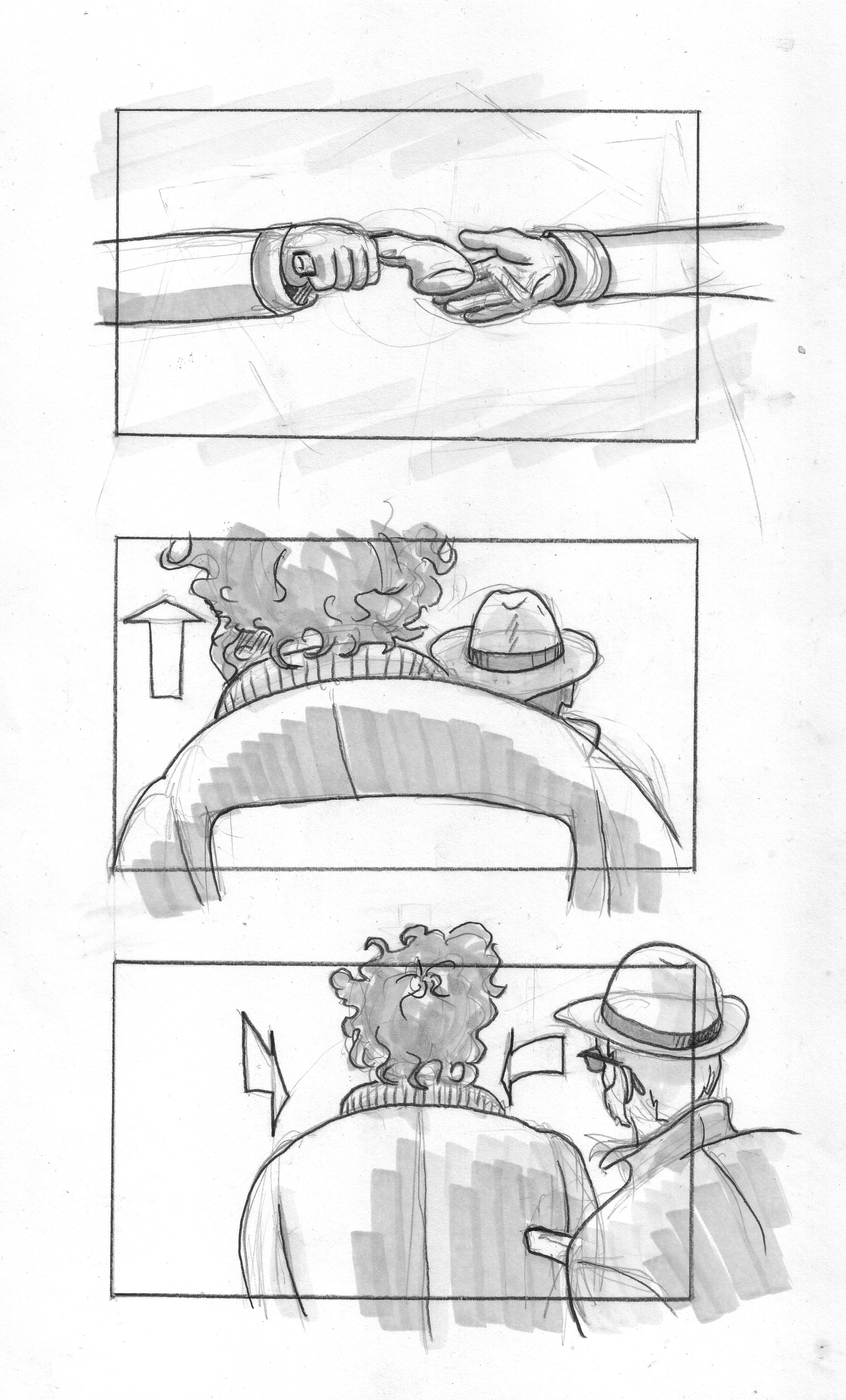
After about a week, the first draft was finished. At this point, I have to agree with Mr. Field: the first version is usually completely useless; it only serves to record the thoughts that have been gathered. At the point where Neuhäuser decides to join in, I had to decide on an ending. I went through all the options in my mind until I settled on the version with Borowski's accidental murder. Everything came together at one point: the end of the bet, the resolution, the agreement between Neuhäuser and Borowski. The scenario takes a 180° turn and Neuhäuser now has a lot of emotions to process. The third person could also be the man at the bar, who is already in the game.
Another four weeks passed before the final version was ready: the third version dated December 13, 2006. All of the criticism from friends pointed to a lack of logic in the story involving the blank cartridges. That was clearly the weak point of the story. So: how does the live bullet get into the magazine with the blank cartridges without the viewer noticing it immediately, but making it seem plausible in retrospect? A subtle mistake by Borowski when loading the gun. But which one? There were plenty of possibilities, but they were all too obvious or too stupid for the character. The final solution came about in a conversation with actor Jan Sosniok, who offered me a version that ultimately worked best.
I couldn't convince Michaela Beck with the ending. She would have preferred a confrontation between Borowski and Neuhäuser, because that would have made the old man's act of revenge more plausible. That's true, but it would have defused the situation considerably, and Neuhäuser's reaction as well. Besides, the ending would have dragged on too long. I decided to stick with my version. I was able to resolve all other issues with corrections from her, my professor, and my fellow students.
